


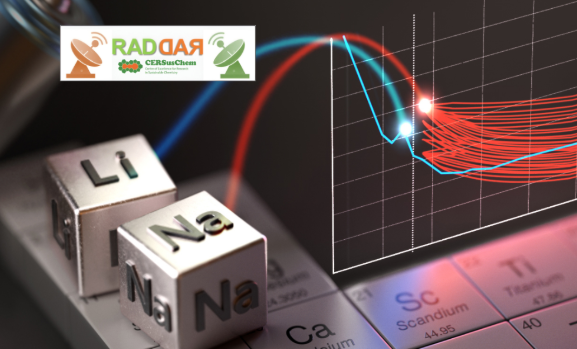
Goodbye to lithium? Studies point to more sustainable sodium-based batteries
Rechargeable batteries are becoming increasingly present in our daily lives. They power consumer electronics such as smartphones and laptops; drive the expansion of electric vehicles, from cars to bicycles and scooters; and support the growth of renewable energy systems, such as residential solar panels paired with energy storage. One of the key components of these batteries is lithium, which, due to rising demand, has become an increasingly important natural resource on a global scale. However, lithium is unevenly distributed around the world, requires costly extraction processes,and poses significant environmental challenges, particularly because of its high water consumption and the generation of large volumes of mining waste.
In search of possible alternatives, a recent review conducted by researchers from several institutions, including the Islamic University of Technology (Bangladesh), Idaho State University (United States), and the University of Waterloo (Canada), and published in Next Energy, an Elsevier scientific journal, compiled and analyzed the current state of knowledge on sodium-ion batteries (SIBs) as a complementary or alternative technology to conventional lithium-ion batteries (LIBs). According to the authors, more than 85% of global lithium production comes from just a handful of countries, mainly Australia, Chile and China. This is because lithium is extracted primarily from two sources: brine deposits in salt flats, found mainly in Chile, and hard-rock mining, where Australia is the world's leading producer. Meanwhile, China controls more than 60% of the world's lithium refining capacity. This concentration of supply, combined with the slow development of alternatives, could make current reserves insufficient in the long term and lead to further price increases.
Given these limitations, the researchers identify sodium-ion batteries as one of the main pathways toward a more sustainable transition from conventional lithium-based technologies. Overall, SIBs offer several economic and environmental advantages due to the abundance of sodium in the Earth's crust. The authors cite studies showing that sodium is up to one thousand times more abundant than lithium, improving supply security and reducing the environmental impacts associated with mining. They also highlight the possibility of using more accessible materials in battery electrodes, including iron and manganese, instead of cobalt and nickel, which are commonly used in lithium-ion batteries but are scarcer and more expensive. From a chemical perspective, sodium-ion batteries (Na⁺) operate in much the same way as lithium-ion batteries (Li⁺): energy is stored and released through the movement of ions between the battery's electrodes. The main difference is that sodium replaces lithium as the charge carrier.
However, performance and service life are still limiting factors, and comparisons presented by the authors help illustrate these differences. In addition to sodium (Na⁺) and lithium (Li⁺), other metallic ions, such as magnesium (Mg²⁺) and potassium (K⁺), can also be used in energy storage systems. Nevertheless, lithium stands out because of its high energy density, meaning it can store more energy in a smaller space, making it particularly attractive for applications requiring long range and lightweight batteries, such as electric vehicles. On the other hand, some sodium-ion battery prototypes have already demonstrated lifetimes of several thousand charge-discharge cycles, suggesting strong potential for applications where durability is more important than compact size. Despite their lower energy density, SIBs remain an attractive option for applications where weight and volume are less critical, such as large-scale electrical grid infrastructure.
To address these challenges, materials engineering, a field dedicated to understanding how a material's structure influences its performance, has been exploring ways to improve the components of sodium-ion batteries and increase their energy storage capacity. One of the main research directions focuses on hard carbon anodes, a type of electrode made from carbon-rich materials, often derived from biomass such as agricultural or plant residues. Hard carbon has a three-dimensional structure filled with pores and channels that facilitate both the storage and movement of sodium ions during charge and discharge cycles. In parallel, researchers are also making advances in electrolytes, the substances responsible for transporting sodium ions between the electrodes. Among the most promising developments are solid-state electrolytes, which are expected to be safer than the liquid electrolytes currently used in most batteries.
Overall, the review shows how multiple research strategies are being developed to improve the efficiency and durability of sodium-ion batteries. As a result, SIBs are emerging as a technically viable and increasingly promising alternative to lithium-ion batteries, particularly for large-scale energy storage applications. Their greatest advantage, however, lies in their potential to support a more sustainable energy transition by relying on fewer critical raw materials and taking advantage of sodium's broad geographical availability, reducing dependence on lithium while lowering manufacturing costs. Even so, the authors do not expect sodium-ion batteries to completely replace lithium-ion batteries, but to complement them in future energy systems.
Read the full article here: https://doi.org/10.1016/j.nxener.2025.100478.