


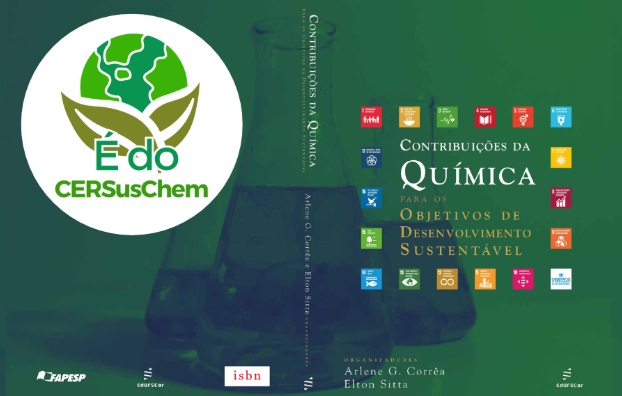
UFSCar faculty members launch book on the contributions of Chemistry to the Sustainable Development Goals
The Sustainable Development Goals (SDGs) comprise a global agenda established by the United Nations (UN) in 2012 to guide actions aimed at building a more sustainable future by 2030. In total, the agenda consists of 17 goals that represent a call for all countries to address some of the most pressing social, economic, environmental and institutional challenges of our time. Among the many fields of knowledge contributing to this effort, Chemistry has played a key role in advancing areas such as energy generation and storage, water treatment, drug development and the circular economy, continuously providing new solutions to challenges related to energy, the environment, food production and health. In this context, and with the aim of highlighting these contributions, the book Contributions of Chemistry to the Sustainable Development Goals was launched on June 16, 2026, during the 49th Annual Meeting of the Brazilian Chemical Society (SBQ), held in Campinas, São Paulo, Brazil.
The publication is the result of a collaborative effort involving researchers from the Center of Excellence for Research in Sustainable Chemistry (CERSusChem), UFSCar’s Graduate Program in Chemistry, and the Sustainability Promotion Committee of the Department of Chemistry at UFSCar. The book was organized by Professor Arlene Gonçalves Corrêa and Professor Elton Fabiano Sitta. Across its 11 chapters, the book first introduces the SDGs, key sustainability concepts and the indicators used to assess them, before gradually moving on to topics that reflect different areas of Chemistry and how they interact with other sectors. These themes include chemistry education, clean water and sanitation, the life cycle of plastics, energy transition, energy storage technologies, deep eutectic solvents, continuous-flow organic synthesis and innovations related to sustainable agronomy.
The launch of the book comes at a particularly relevant moment for these discussions. Following the 30th United Nations Climate Change Conference (COP30), held in Belém, Pará, Brazil, in 2025, debates on strategies to mitigate the impacts of climate change and promote more sustainable development models have gained even greater visibility. Thus, beyond presenting scientific advances, the publication seeks to “encourage the scientific community to work through Chemistry to achieve the SDGs,” says Professor Arlene Gonçalves Corrêa in an interview with CERSusChem, available at this link. The book is primarily intended for undergraduate and graduate students in Chemistry, as well as related fields such as teacher education programs, engineering, and biological sciences. This and other book launches presented during the 49th Annual Meeting of the Brazilian Chemical Society can be found at: https://www.sbq.org.br/49ra/pagina/lancamento-livros.php.