


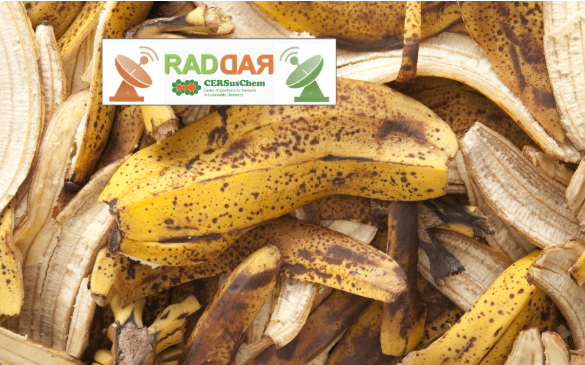
Banana waste gains new value in sustainable water treatment
Transforming agroindustrial waste into products with new applications is an important strategy for addressing environmental challenges related both to waste management and to the preservation of natural resources. Among these residues, banana peels stand out due to their wide availability and large volume of disposal, especially considering that Brazil is the fourth largest banana producer in the world. In this context, a study conducted by researchers from the Federal University of Viçosa (UFV) and recently published in the Journal of the Brazilian Chemical Society identified an alternative use for this material: its application in the sustainable production of biochar, a carbon-rich substance capable of removing iron and manganese ions from aquatic systems.
The excessive presence of these metals in natural and groundwater sources is a recurring problem in many regions and can compromise water quality, causing unpleasant odors and coloration, which impacts both human consumption and industrial use. Fortunately, different methods can be employed to remove these contaminants, including the use of adsorbent substances, porous carbon-based materials capable of retaining metal ions. To produce these materials, biomass derived from agricultural residues can be used as raw material, as it represents a renewable source of carbon. Through carbonization - a process involving controlled heating of biomass to concentrate carbon - biochar is formed. In this study, the authors carried out biomass carbonization through hydrothermal processing, also known as wet pyrolysis because it occurs in an aqueous environment, transforming banana waste into hydrochar.
From the synthesis of hydrochar, the researchers were able to evaluate the ideal conditions for producing this material sustainably without compromising its efficiency. To achieve this, they investigated how different variables, including reaction time, temperature, and the use of phosphoric acid or sodium hydroxide as activating agents, could influence the hydrochar’s ability to attract and retain metals on its surface. Among the samples tested, hydrochar produced at 150 °C for 11 hours using only water (without activating agents) showed the best performance. Advanced analyses, including X-ray diffraction and infrared spectroscopy, techniques that reveal the structure and chemical bonds of the material, confirmed the high presence of oxygenated and nitrogen-containing functional groups, regions on the material's surface that favor the interaction and adsorption of metal ions.
Overall, the research presents an accessible and sustainable solution for removing heavy metals from water by transforming banana peels into an adsorbent material for this purpose. One of the main strengths of studies like this is their ability to highlight the fundamental role of the circular economy in promoting sustainability, demonstrating that agroindustrial residues, often discarded without proper reuse, carries a valuable potential for transformation into new products. To explore all the details of the study and the adsorption capabilities of hydrochar, read the full article at: https://dx.doi.org/10.21577/0103-5053.20250169.