
46th Summer School in Chemistry promotes a scientific week with the participation of CERSusChem and international guests
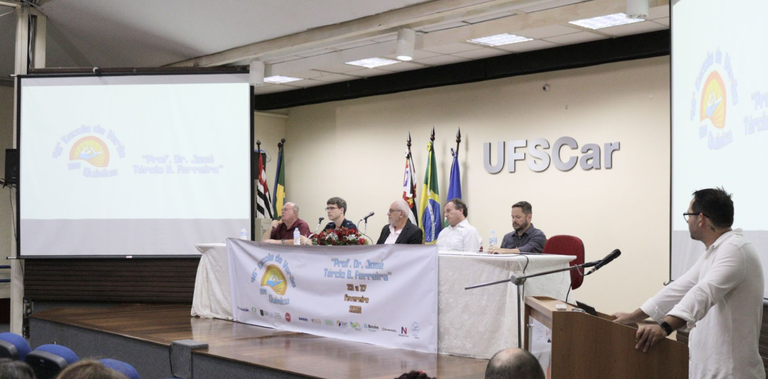
The 46th Summer School in Chemistry (EVQ), conducted last week, reaffirmed its role as one of the most traditional and relevant events in the field in Brazil. Organized by the Department of Chemistry (DQ) and the Graduate Program in Chemistry (PPGQ) at the Universidade Federal de São Carlos (UFSCar), the EVQ has connected researchers and students from different institutions, both in Brazil and abroad, since 1981, fostering scientific collaboration and expanding research opportunities. “The EVQ is very important for strengthening our graduate program because it promotes interaction among students and researchers from different backgrounds. The event has already led to numerous partnerships that enabled our students to go abroad to complete their studies and implement new technologies,” highlights Professor Ricardo Samuel Schwab, coordinator of the PPGQ and researcher at the Center of Excellence for Research in Sustainable Chemistry (CERSusChem).
The opening of the program featured two workshops that marked the beginning of the week. The first, entitled “Chemistry in Three Dimensions: Connections between Science, Internationalization, Education, and Technological Transformation,” brought together faculty members affiliated with CERSusChem: Professor Arlene Gonçalves Corrêa and Professor Lucia Helena Mascaro, as well as Professor Maria Fátima da Silva from the DQ. Drawing from their academic trajectories, the speakers demonstrated how to build a solid career in Chemistry, emphasizing that impact arises from the integration of academic development within the university, international experiences, and innovation-oriented research, all key aspects in preparing strong professionals today.
During her presentation, Professor Arlene G. Corrêa introduced CERSusChem as a model that combines high-level research with technological innovation, education and science outreach. Among the center’s initiatives, she highlighted environmental education actions in the local community, the reception of high school students in research laboratories and the production of science communication content for social media. Likewise, Professor Lucia H. Mascaro emphasized that research fulfills its transformative role only when it goes beyond the laboratory and truly reaches society. Publishing scientific articles is essential, but engaging with the public and translating complex science into accessible language is crucial for achieving real societal impact.
The second workshop, “Connections between Artificial Intelligence, Renewable Energy, and Molecular Transformation,” brought together a distinguished international panel to discuss the interfaces between chemistry, energy, and data science. Participants included Professor Annemieke Madder from Ghent University (Belgium); Professor Eugénie Romero-Laboureur, scientific researcher at CEA Paris-Saclay (France); Professor Jens Oluf Jensen from the Technical University of Denmark (Denmark); and Professor Marcos Gonçalves Quiles from the Universidade Federal de São Paulo (UNIFESP). Throughout their presentations, the speakers shared their work across multiple areas of Chemistry, ranging from the development of new pharmaceuticals and methodologies in organic synthesis to sustainable energy production and the application of artificial intelligence in chemical research.
The week’s program also included short courses taught by the invited researchers. Professor Annemieke Madder addressed advances in drug development based on the modification of biological molecules, including proteins and nucleic acids, enabling more targeted treatments with a lower risk of side effects. Professor Eugénie Romero-Laboureur discussed the use of an accessible automated method that allows hundreds of chemical reactions to be tested in parallel, serving as a valuable tool for making research faster, more organized and more predictable.
Professor Jens Oluf Jensen presented recent advances in green hydrogen production through water electrolysis, expanding discussions on energy transition and carbon footprint reduction. In addition, a short course jointly conducted by Professor Márcio Weber Paixão and Professor Lucia Helena Mascaro, members of CERSusChem, and Professor Ernesto Chaves Pereira explored the potential of CO₂ for the production of fuels via electrocatalysis and other products of broad industrial interest. Once again, sustainability emerged as a central theme among the training activities offered by the EVQ, which has historically incorporated themes aligned with the principles of green chemistry into its program. You can watch highlights from the event in the video available on our YouTube channel at the following link: https://youtu.be/UjUo1A9otaU?si=RKpoPNsM9inKscxA